Rules Manual
Welcome to the Middle-earth Strategy Battle Game, the hobby of collecting, painting and gaming with all of your favourite characters and warriors from The Lord of the Rings™, The Hobbit™ and The War of the Rohirrim™ using beautifully detailed Forge World and Citadel miniatures. If you have ever wanted to explore the wonderful world of Middle-earth, its races, factions and memorable heroes, then this is the hobby for you.
Chances are that many of you reading this will have never played a tabletop wargame before, and so the tome you are holding may seem a little daunting at first glance to newer players. But fear not, within the pages of the Middle-earth Strategy Battle Game Rules Manual you will be guided upon your journey into the fantastic realm of tabletop wargaming, with all of the rules laid out for you in a clear and easy to follow manner, complete with examples that will help explain everything to you and clear up any questions you may have. There is also a handy index at the back of this manual, which will help you find any rules you need to reference quickly and easily.
MIDDLE-EARTH IN MINIATURE
Many of us who have followed the stories set in Middle-earth - whether The Lord of the Rings™, The Hobbit™ or The War of the Rohirrim™ - have at some point dreamt of being part of the action; striding into battle alongside our favourite characters, going on adventures within the epic landscapes, or simply just strolling along the paths of the Shire. The Middle-earth Strategy Battle Game allows you to recreate your favourite moments, transporting you to Middle-earth and letting your imagination run wild.
If you are reading this, then there is a good chance that you have already seen a selection of the stunning range of Citadel and Forge World miniatures of the various characters and creatures from all aspects of Middle-earth. In fact, it is a distinct possibility that you may own one or two already!
This Rules Manual is here to guide you on your journey through collecting and gaming with your own collection of finely detailed Middle-earth miniatures, so that you can get the most fun and enjoyment out of them. Whether you simply want to collect your favourite heroes, villains and creatures from Middle-earth, or you wish to gather a mighty army of Men, Elves, Orcs or another army of your choosing and do battle with your friends, this Rules Manual is here to guide you every step of the way.
HOW TO USE THIS RULES MANUAL
The Middle-earth Strategy Battle Game Rules Manual contains within its pages all of the information that you will need to organise your collection and play exciting games set in the world of Middle-earth. The game allows you to faithfully recreate your favourite battles and scenes from The Lord of the Rings™: Motion Picture Trilogy, The Hobbit™: Motion Picture Trilogy and The War of the Rohirrim™.
This Rules Manual contains all of the rules you will need to play games set within Middle-earth, including moving and shooting, fighting in close combat, using magic and even fighting in epic siege battles.
This Rules Manual also contains a selection of specially written Matched Play Scenarios, perfect for use in tournaments and other organised play environments, or just to test your skills and generalship against your friends using armies built to the same criteria.
The profiles for all your favourite heroes, warriors and creatures can be found within the relevant army supplement: Armies of The Lord of the Rings™, Armies of The Hobbit™ or Armies of Middle-earth™.
PLAYING THE GAME
Those of you who have never played a tabletop wargame before may be wondering how it all works; after all, it can seem quite strange to you if you don't know what's going on! Over the next few pages, we will look at how you go about setting up and getting started with your first game of the Middle-earth Strategy Battle Game.
The first thing you need, and possibly the most important, is a friend to play your games with and join you on your hobby journey. You will then need to decide what kind of game you wish to play - there are two main ways to play the Middle-earth Strategy Battle Game:
-
Narrative Play - Recreate all of your favourite scenes and battles from the films and books using your collection of Citadel and Forge World miniatures... and perhaps even change the very fate of Middle-earth through the outcome of your games. You will find more details on Narrative Play on page 150.
-
Matched Play - Organise your collection into mighty armies capable of taking on all comers, using the Army Lists, profiles and points values found within one of the various supplements. Then, battle with your friends in a test of skill, wits and tactics to see who will emerge victorious! More details on Matched Play can be found on page 152.
Of course, there is nothing stopping you from playing the Middle-earth Strategy Battle Game in your own way; playing games with your own rules, creating unique alliances and scenarios, and simply just playing the game in whatever manner suits you best - that is all part of the fun of the game!
SETTING UP THE BATTLEFIELD
Most Narrative Play and Matched Play games will have instructions and ideas on how to set up the battlefield ready for your game, including maps and even photos to help guide you. In addition, in each Scenario there will be an idea given of what the terrain should be.
If you don't have all the terrain that is recommended, don't panic! You can still play the game with a bit of improvisation and imagination - most wargamers play their first games with books standing in for hills and ruins, and even rocks and twigs from the garden as forests and areas of mountainous terrain.
CHOOSE FORCES
Every Narrative Scenario contains a list of participants to help you put together a game that faithfully recreates the scenes from the films, and will require no small amount of cunning and wits to emerge victorious. In Matched Play games, players will build their Armies to a predetermined points value before the game and using the various Army Lists presented in the supplements, allowing you to build a competitive force based upon the scenes presented in the films and the books.
OBJECTIVES
Every Scenario has a series of rules and objectives that the forces are trying to achieve. In Narrative Play games, the objectives both sides are trying to accomplish will mirror those seen in the films, allowing players to play in the same way as the armies they see on-screen. Sometimes these will be completely different from each other, especially if the Armies are trying to complete different missions. In Matched Play games, both players will have the same objectives they are trying to accomplish and will be trying to obtain a number of Victory Points by doing so. These Matched Play Scenarios are always balanced, and players can achieve up to a maximum of 20 Victory Points in each Scenario.
THE RULES
The rules are what make the game work on the tabletop. They govern all aspects of play, from how far a model can Move, whether a model successfully hits a target with an arrow, to how many Attacks a model has in a fight. The rules may seem a little intimidating at first, but don't be put off - after a game or two they will all seem like second nature!
CHARACTERISTICS
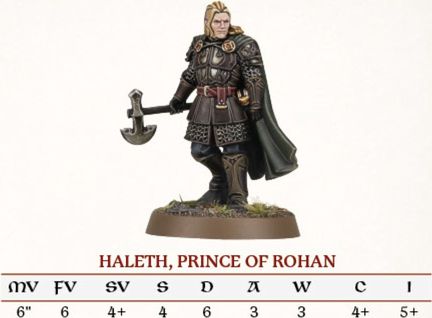
Every model, from the most valorous of Men to the most repulsive of Orc, has a profile that reflects how powerful they are and what they can do on the battlefield. A profile is a collection of letters and numbers that at first glance may seem confusing but is quite simple once it has been explained. Each of these relates to a specific aspect, and during the course of a battle you will often be referring to these to see which model wins a fight, if a model delivers a wounding blow, and all manner of situations.
Here we describe what each of these characteristics are and what they mean:
Move Value (MV) - The model's Move Value tells you how far in inches (") a model may Move during each of its activations.
Fight Value (FV) - Fight Value denotes how good the model is at fighting in hand-to-hand Combat, with the higher the number the more skilled the model is in Combat. Fight Value can never be increased to more than 10 or reduced to below 1.
Shoot Value (SV) - Shoot Value shows how skilled the model is with a Missile Weapon. It is represented by a target number, a number followed by a "+" symbol, which shows what result on a D6 is needed in order for this model to hit a target with a Shooting Attack. As a result, the lower the Shoot Value, the better the model is at Shooting. Shoot Value can never be improved to better than 2+ or worsened to worse than 6+.
Every model has a Shoot Value, although not every model has access to a Missile Weapon. If a model cannot Shoot for whatever reason, you can simply ignore their Shoot Value.
Strength (S) - This is how strong the model is, and will be used when a model makes attacks in Combat to work out how easily they can wound their opponent; the higher a model's Strength characteristic, the easier it is to wound an enemy model in Combat.
A model's Strength can never be increased to more than 10. However, should a model's Strength ever be reduced to 0, then they are immediately removed from the battlefield and counted as a casualty.
Defence (D) - Simply put, this is how tough or durable a model is. If a model is clad in thick armour, or is inherently resilient, it will have a higher Defence. The higher a model's Defence, the less likely they are to be wounded by enemy shooting or combat attacks. A model's Defence can never be increased to more than 10 or reduced to below 1.
Attacks (A) - The Attacks characteristic represents how many blows a model can land on an enemy in Combat. It literally translates into how many dice the model will roll during a Combat, both for the initial Duel Roll and when making Strikes against an enemy.
Wounds (W) - This denotes how many injuries a model can take before succumbing to their wounds. If at any point a model's Wounds are reduced to 0, they are immediately removed from the battlefield as a casualty. Most models have a single Wound, and so will be removed as soon as they are wounded. However, some characters and creatures will possess more, and can suffer more Wounds before being removed as a casualty.
Courage (C) - A model's Courage denotes how brave they are in the face of terrifying odds. It is represented by a target number and when a Courage Test is required, it is done by rolling 2D6 and comparing the result to this characteristic. The better a model's Courage (in this case lower), the easier it is for them to pass such a test and the braver they are. A model's Courage can never be improved to better than 3+ or worsened to worse than 10+.
Intelligence (I) - Intelligence represents how smart a model is. It is represented by a target number and when an Intelligence Test is required, it is done by rolling 2D6 and comparing the result to this characteristic. The better a model's Intelligence (in this case lower), the easier it is for them to pass. A model's Intelligence can never be improved to better than 3+ or worsened to worse than 10+.
Might, Will, Fate - Models with the Hero keyword will possess three additional characteristics: Might, Will and Fate. Unlike other characteristics, these are represented by a store of points that can be spent during a game. A Hero can use these points to perform special actions, avoid harm, and all manner of other heroic feats - however, once they have been spent, they are gone for the remainder of the game. Might, Will and Fate are covered in more detail in the Hero section later on page 74.
ANATOMY OF A PROFILE
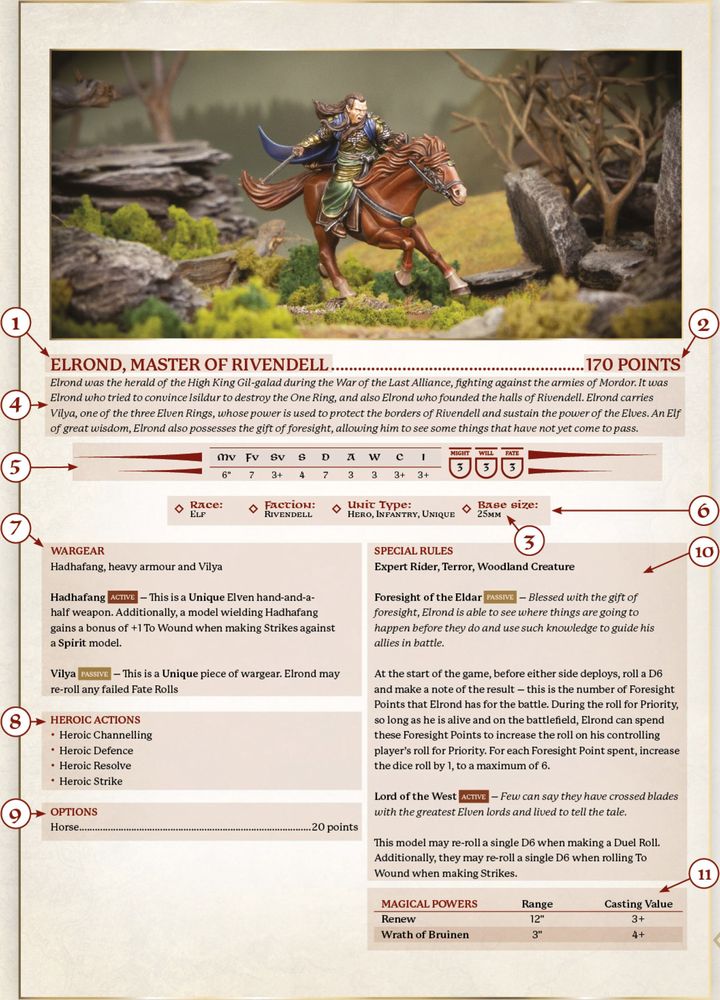
Shown opposite is an example of a profile for the Middle-earth Strategy Battle Game, in this case Elrond, Master of Rivendell. Whilst at first glance this profile may seem rather confusing if you haven't seen one before, it is actually really simple to understand. Here we will take you through each part of a model's profile and explain what each bit means - that way you will be able to understand it all in no time!
1. CHARACTER'S NAME
This provides the name of the profile in question; essentially, who this character is. Sometimes these may provide a title, and will often help to denote which part of the story this version of the character is from. It is important when you are writing an Army List that you use the full name of the profile, as certain characters may have more than one. For example, Aragorn has two profiles: one as Strider and one as King Elessar.
2. POINTS VALUE
Here you will find the cost in points for the model. The points value given is for the whole profile, with the exception of any options they may be able to purchase - these are explained in point 9.
3. BASE SIZE
This is the base size that the model must go on. It will always be a circular base, unless the profile specifically states it is an oval. Some models come as Cavalry models, however, the base size shown in the profile will be that of the Infantry model should they be dismounted. Whilst mounted, the model will always use the base size of the Mount, which can either be found in the Cavalry section (see page 71), or in the model's profile.
4. BACKGROUND TEXT
The text here describes the character the model is representing, giving some context as to who the hero, warrior or creature is and how they fit into Middle-earth.
5. CHARACTERISTICS
Here you will find all of the profile's characteristics, as mentioned on page 7. If the profile has the Hero keyword, then you will also find the Might, Will and Fate characteristics here as well.
6. KEYWORDS
Here you will find all of the keywords associated with the profile. These are split into three types: Race keywords such as Man, Elf, etc., Faction keywords such as Rohan, Mordor, etc., and Unit Type keywords such as Infantry, Cavalry, etc. Many rules will reference keywords to explain which models are affected.
Here we can see that Elrond has the Elf, Rivendell, Hero, Infantry and Unique keywords. For more on keywords, see page 19.
7. WARGEAR
Every model in the Middle-earth Strategy Battle Game has a selection of wargear that comes with their profile, as listed here. The rules for this wargear can usually be found in the Weapons & Wargear section on page 102. Sometimes, a profile will have specific items of wargear that are unique to them. In these instances, the rules for that wargear will be listed in this section. Here we can see that Elrond has both Vilya and Hadhafang, with the rules for them listed in this section.
8. HEROIC ACTIONS
Hero models can spend Might Points to declare Heroic Actions. Some of these are available to every Hero, others are only available to specific Hero models. Here will be listed all of the specialised Heroic Actions the model can declare. If there are no Heroic Actions listed, then the Hero cannot declare any of the specialised Heroic Actions. For more on Heroic Actions, see page 78.
9. OPTIONS
Profiles may have a list of options that can be purchased for the model, for the shown points cost. These can include the likes of weapons, armour, mounts, or wargear. Warrior models will only be able to take a single option from the list. If it states a Warrior must take one option, then it is mandatory to take an option. If it states that a Warrior may take one option, then they do not have to take an option if they don't wish to. Hero models may take any of the options listed in their profile in any combination.
10. SPECIAL RULES
Profiles may have a selection of special rules that represent the wide variety of abilities they possess. Some of these will just have the name of the special rule under the header, in which case the effect of the special rule in question can be found in the Special Rules section on page 122. Others that are unique to the profile will have the full effect of the rule listed, along with if it is Active or Passive (see page 123).
11. MAGICAL POWERS
In Middle-earth, a number of beings have the ability to manifest magical powers. If the profile is able to Cast any Magical Powers, they will be listed here along with their range and Casting Value. The full effects of the Magical Powers can be found on page 112.