Unit Types
To be successful in battle, an army will need to muster various types of warriors, creatures, war machines and experienced leaders to guide their followers forwards to secure victory. The most powerful armies have a blend of all manner of units and know how best to utilise them on the battlefield to bring ruin upon their foes. From humble blocks of infantry, to galloping formations of cavalry and hulking monsters that stomp around the field of battle, there are numerous types of units available to a general - and the very best will know how to get the most from each of them.
Every profile in the Middle-earth Strategy Battle Game has a number of keywords on it (as described on page 19), divided into three sections: Race, Faction and Unit Type - the latter of which we will cover here.
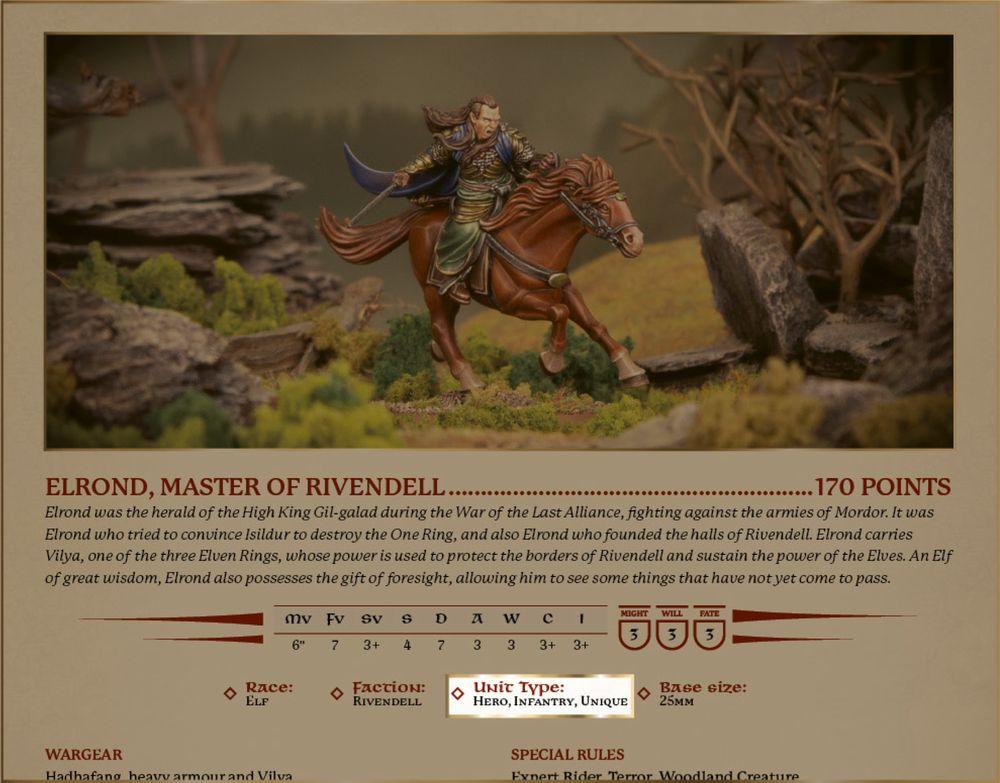
A profile's Unit Type keywords denote the model's role on the battlefield. Whether it be a simple Warrior designed to make up the battleline of a force, or a Hero whose job it is to lead the army in the art of warfare, and so on.
Many Unit Type keywords have additional rules associated with them. Some of the more common ones have sections in this Rules Manual that explain how they work in more detail, whilst others are explained fully on this page. On the following pages are a list of the various different Unit Types you will encounter in this game.
INFANTRY
This is the term used to describe a model on foot; essentially a model not riding a Mount, war machine or composed in some other unusual manner. Most models in the game will be classed as Infantry models, and the Infantry keyword has no additional rules associated with it.
CAVALRY
Models that are riding on a horse, Warg or some other ridden beast are classed as Cavalry models. Cavalry models have a number of additional rules that govern how they work, which are outlined fully in the Cavalry section on page 66. If a Cavalry model becomes dismounted, then the rider will exchange their Cavalry keyword for the Infantry keyword. Additionally, an Infantry model that purchases a Mount will exchange their Infantry keyword for the Cavalry keyword whilst they remain mounted.
MOUNT
The part of a Cavalry model that is being ridden will often have the Mount keyword. A Mount has no specific rules associated with it, though will be referred to often in the Cavalry section (see page 66). There may be rare situations where the ridden part of a Cavalry model does not have the Mount keyword.
A Mount that is also a Hero cannot declare Heroic Actions.
MONSTER
Monster models are those big, imposing creatures that can have a great impact on the direction a battle can take. As a result, Monster models have a number of additional rules that govern how they work. These are covered in the Monsters section on page 88. Many Monster models will also have another Unit Type keyword, usually either Infantry or Cavalry.
WAR BEAST
The term War Beast describes the great, lumbering creatures ridden to war by many of their allies, and are used to trample their foes underfoot. A War Beast has a number of additional rules explaining how to use these complex models, as detailed on page 92.
CHARIOT
A Chariot is a type of war machine pulled by the likes of horses, goats or some other beasts. They are primarily used to charge into the fray and allow the rider to fight from an elevated platform. Chariot models have their own section detailing how they work on page 98.
SIEGE ENGINE
A Siege Engine is a term for the huge weapons of war used to batter down gates and walls in the event of a siege. Siege Engine models have their own section detailing how they work on page 138.
HERO
Hero models are the lifeblood of the Middle-earth Strategy Battle Game as they act as the focal point of an Army and allow the player to use a number of unique actions to command their Army on the battlefield. Hero models are easily identified not just by the Hero keyword, but also by the presence of the Might, Will and Fate characteristics. Hero models have a number of additional rules that explain how they work on page 74.
WARRIOR
A model that is not a Hero will be described as a Warrior - those that follow their leaders into battle. Warrior models have no additional rules associated with them.
UNIQUE
Many of the characters in Middle-earth are individuals, i.e., they are one of a kind. You can only use one of each model with the Unique keyword in your Army - for example, you can't take two Gimlis. Additionally, some characters may have multiple profiles representing them at different times - such as Gandalf the Grey and Gandalf the White. Again, you can only ever take a single one of these Unique characters, even if they have different profiles.
Some items of wargear will also have the Unique keyword and may be able to be taken by multiple characters, such as Orcrist. Again, you can only include a single copy of a Unique piece of wargear in your Army; though if there is a choice about who can wield it, that choice is up to you.
BEAST
A Beast is a model that is a creature rather than a more humanoid figure, and one that will usually act on instinct or training. A Beast does not have the ability to pick up items and use them, and so can never pick up wargear (such as being passed a banner) and cannot carry or be passed Objective Markers in Scenarios that use them - unless otherwise specified. A Beast can never act as Untrained Crew (see page 142).
SWARM
Some smaller creatures will act as a Swarm rather than as individual creatures. A Swarm is very hard to pin down, and as a result a Swarm can never become Prone or be considered to be Trapped.
ELITE
An Elite model is one that is more than the standard rank and file of an Army, and will only usually follow certain characters into battle. A model with the Elite keyword can only be included in the Warband of a Hero who has the Leader (X) special rule, where X is the name of the Elite model. So, a Citadel Guard (which is an Elite model) can only be included in the Warband of a model with the Leader (Citadel Guard) special rule.